Check your bathroom socket before you check anything else
This is the one decision that will actually ruin a purchase in this price range, and almost no listing tells you about it. India uses two three-pin sockets that look alike: the small 6A Type-D that every bedroom and bathroom has, and the much larger 16A Type-M fitted for air conditioners, geysers and fridges. A 16A plug physically will not enter a 6A socket — the pins are too thick. At 230 V a 6A plug can carry about 1,380 W, so any dryer genuinely drawing more than that is sensibly and legally fitted with the bigger plug. ₹2,000–₹5,000 is precisely the range where dryers cross that line, which produces the perverse result that buying more power buys you a plug that fits fewer sockets in your own home. Look behind your mirror first. If there is no 16A point there and you do not want an adapter, restrict yourself to the lower-wattage picks. If you do use an adapter, buy one properly rated for 16A — a cheap converter carrying nine or ten amps continuously is itself a fire risk.
The plug rating is also the most honest wattage figure on the page
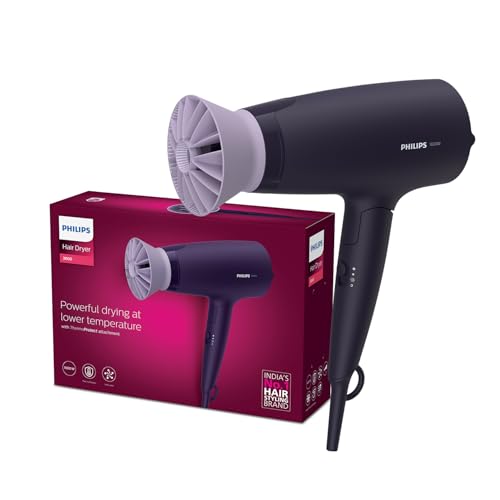
Wattage claims in this band are marketing. The plug is not — it is set by the current the dryer actually draws. So a dryer labelled 2000 W that ships a normal 6A plug is almost certainly not drawing 2000 W, and one that ships a 16A plug genuinely is pulling close to its sticker. You can use this in reverse when the listing says nothing, which is most of the time: read the reviews. A product with hundreds of Indian reviews and no plug complaints at all has a 6A plug. Among the dryers we evaluated, the AGARO Royal drew no plug complaints across 96 reviews and the Ikonic Pro 2100+ none across 135, while the Philips BHD318 drew 27 of them from the same number of reviewers.
Brushless beats wattage, and this is the band where you can finally buy one
A conventional hair dryer uses a brushed motor spinning around 20,000 rpm. A BLDC brushless motor spins at 105,000–130,000 rpm, moving far more air at much lower wattage — which is why a 1250 W brushless dryer can dry faster than a 2400 W conventional one while using half the electricity and doing less heat damage. Below ₹2,000 brushless essentially does not exist; above about ₹4,000 it becomes normal. That break falls inside this band, which makes ₹2,000–₹5,000 the first price range where you have a real choice between the two technologies — and the Pigeon Elegant at ₹2,052 shows the break is not absolute. If your hair is fine or you dry it often, brushless is the better buy. If your hair is very thick and you want maximum hot airflow, a strong 2400 W AC motor still has more raw heat. Our under-₹2,000 roundup covers the band where brushless is not yet an option.
Never pay for a cool shot without checking that it works
The cool shot — a burst of cold air that sets a style after blow-drying — is the most commonly advertised and most commonly broken feature in Indian hair dryers. Across this research it failed on multiple popular models, with owners reporting that the cool setting blows warm air, works only at low speed, or stops working within months. One five-star reviewer of a leading model wrote that the "cool features is somehow fake" while still rating the product highly. Two things to watch: a dedicated cool-shot button is a real feature, whereas a "cool mode" or "cooling setting" is often just the lowest heat position; and whatever the listing claims, search the reviews for the word "cool" before you buy.
Judge reliability on recent reviews, not the star rating
The headline star rating covers a product's entire history, and on high-volume listings it is systematically misleading. The clearest example we found: a dryer showing 4.3 stars across more than 25,000 ratings, ranked second in its whole category and selling over a thousand units a month, had 46 of its last 100 verified Indian reviews at one or two stars, averaging 2.9. Early reviews, often from a product's launch period, keep the lifetime average high long after quality has slipped. Sort reviews by most recent, filter to verified purchases, and read the last twenty before trusting any number near the title.
A removable rear filter is the cheapest longevity feature there is
Hair dryers pull air in through a rear grille, and that grille collects hair and dust every time you use it. As it clogs, airflow drops, the motor works harder and runs hotter, and eventually it burns out — which is why "stopped working after a few months" is the most common failure complaint in this category. A filter that unclips for cleaning lets you prevent that in about thirty seconds a month; a sealed one does not. Of the dryers here, the Skince Sonic, Ikonic Pro 2100+ and Wahl Super Dry all have one. It is rarely advertised prominently and it matters more than most of what is.
Separate a bad product from a bad delivery
A surprising share of one-star reviews in this band are not about the dryer at all — they are about a box that arrived with the nozzles missing, or a visibly used unit sold as new. Those are packing and fulfilment failures, and they say nothing about whether the product works or lasts. When you read negative reviews, sort them mentally into three piles: the thing broke, the thing was never in the box, and the thing does not fit my socket. Only the first tells you about build quality, and a product with a high negative rate driven mostly by the second can still be a good buy. Both AGARO models and the Ikonic here score better on reliability than their raw star counts suggest for exactly this reason.